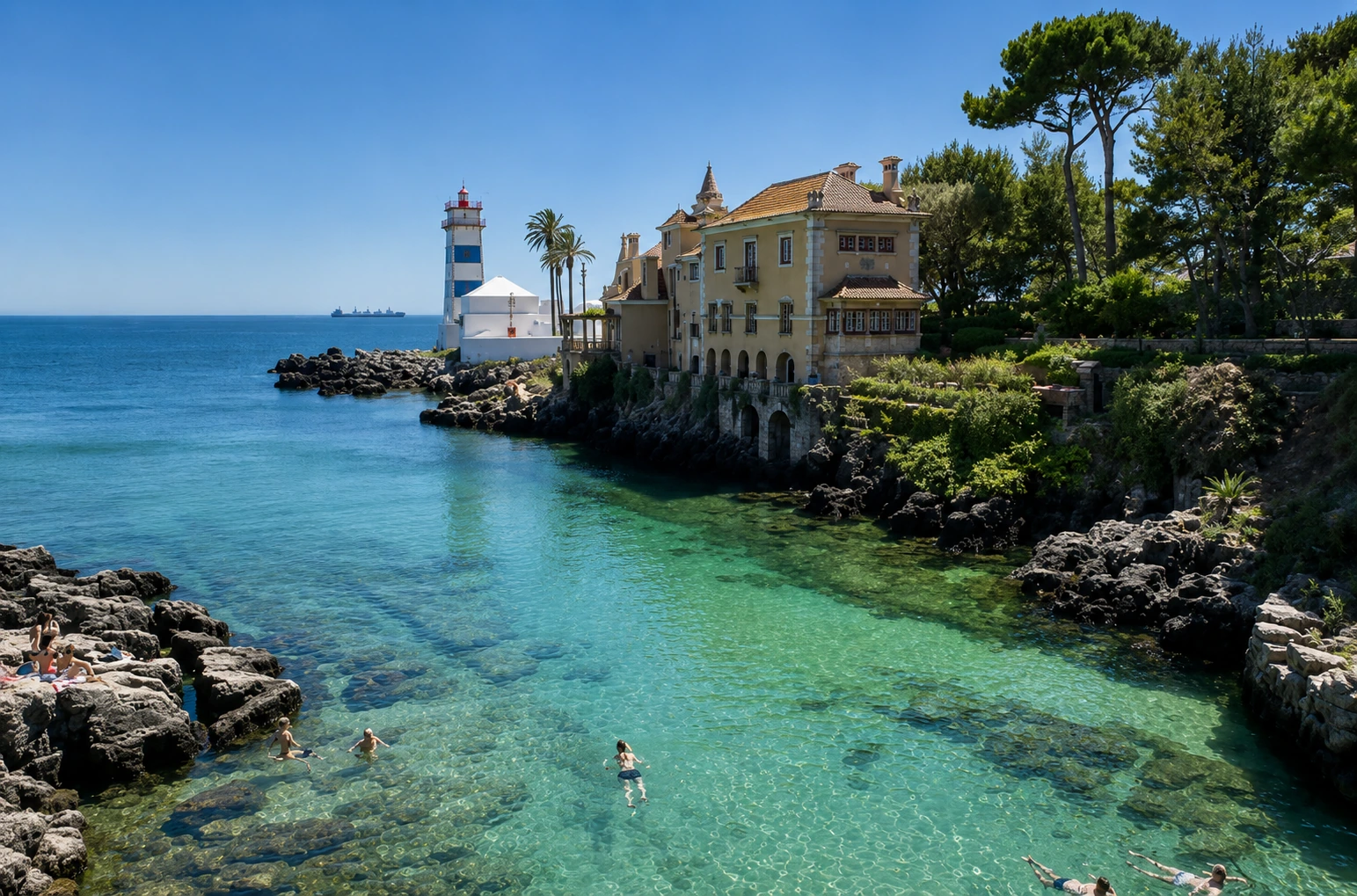
For decades, the Linha was the seaside retreat of the Portuguese aristocracy and upper bourgeoisie. Many of those families never left — they settled, built roots, and what had begun as a summer escape became permanent life. That legacy did not remain trapped in the architecture. It became an imaginary.
Today, to live in Cascais or Estoril is rarely simply to live near the sea. It is to integrate into a recognisable way of living, of educating one's children, of moving in society — a symbol that Portuguese culture identifies immediately.
But not everyone who chooses the Linha is seeking the same thing. Some are drawn, above all, by quality of life — sea, space, pace, golf courses, surf beaches, distinguished clinics, internationally regarded spas. Others seek belonging — to join a community they already recognise as their own. And there are those who seek the symbol itself.
Moments of affirmation: the consolidation of a social position already established, or the explicit desire to build one through the place where one chooses to live.
These three motivations coexist within the same territory, and rarely does anyone belong entirely to just one. Reading this context well means understanding, for each family, which carries the most weight — because the right house for those seeking tranquillity is seldom the same as the one that serves those seeking to be recognised by an address.
A life with sea, space, and an international community consolidated across generations — together with a culture of its own, a recognisable social code that crosses nationalities.
Belonging to a tradition of more than a century, sea, space, and an established international social life — without needing to build it from nothing.
Those who choose the Linha for the image alone, without understanding whether they are seeking tranquillity, community, or visibility, risk acquiring the wrong symbol for the right motivation.